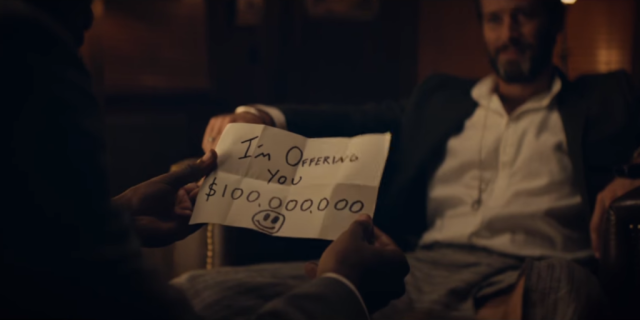
Top: But I’m a Cheerleader, dir. Jamie Babbit, 1999
Bottom: Sorry to Bother You, dir. Boots Riley, 2019
Satire can be a versatile and engaging vehicle in film. In “State of Satire, Satire of State,” the authors write, “If all humor plays with social norms, all humor carries the potential for reflection on, or even criticism of, those norms” (Gray, Jones, and Thompson 2009, 9). Both the films Sorry to Bother You (Lionsgate 2019), directed by Boots Riley, and But I’m a Cheerleader (Universal 1999), directed by Jamie Babbit, utilize campy, exaggerated scenarios and an absurdist humor to prompt audiences to reflect on oppressive and unjust systems. As written by Gray et al., “This process and ‘reflection’ may be unconscious, but humor always, at least potentially, offers the possibility of defamiliarization… inviting us to become philosophical spectators upon our lives. It is practically enacted theory” (2009, 9). Both films act as poignant critiques of systemic oppression under capitalism; But I’m a Cheerleader pokes fun at the absurdity of policing gender and sexuality, and Sorry to Bother You examines the ties between labor exploitation, neoliberal politics, and race.
Satire has a range of visual and auditory modes through which it can be applied. The greatest benefit in employing satire through film is the same principle countless propagandists throughout history have emphasized: film is a medium that reaches the masses. Most come to the theater seeking entertainment, and while these films certainly deliver in punchlines, the end result is opposite that of a lighthearted comedy. As Roman satirist Horace said on his preference for satire, “it deals with important issues in a simple, approachable manner, thereby bridging the divide between philosophy and the general public” (Gray et al. 2009, 14). A filmmaker creating a satire with the intent of challenging currently constructed social systems has a large challenge in executing their overall world-building. It must be familiar enough to make an emotional impact, with fully developed characters whose exaggerated accuracy holds a mirror up to audiences. Simultaneously, its visual humor, witty dialogue, increasingly absurd scenarios, and frequent use of vibrant color and camp must be effective at engaging audiences with content they might otherwise be uninterested in, surpassing commonly held internal biases.
It is easy to fall into cycles of complacency, and satiric storytelling affords audiences the opportunity for reflection. Mary Dougal writes, “A joke is a play upon form that affords an opportunity for realising that an accepted pattern has no necessity” (Gray et al. 2009, 9). In Sorry to Bother You, protagonist Cassius Green and his fiancé Detroit at first present to live in a world very similar to ours, if with some exaggeration for humor: Cassius wakes up for work in the morning and laments his feelings of unfulfillment; he spars with his landlord over rent (it’s later revealed to be his uncle); his car is so damaged it requires a handmade pulley system to work the windshield wipers when it rains. Even his new office job in phone sales seems like your average office comedy, if with a bit more symbolism. For the average viewer, the film’s dystopian qualities begin to bleed through more and more through the horrifying yet all-too-realistic concept of the company Worryfree, their “lifetime contracts” and sanitized commercials. Slowly, the two worlds converge, and as Cassius rises in the ranks at the company, it’s exposed just how connected Worryfree and the telemarketing union truly are. It is a slow build filled with off-putting moments gluing viewers to the screen until the jarring climax.
But I’m a Cheerleader uses a similar format in its narrative to engage the audience in its social commentary. Protagonist Megan is introduced as your typical all-American teenager. In her words: “I get good grades. I go to church. I'm a cheerleader!” But audiences can clearly see the film’s use of situational and visual comedy as Megan discusses her boyfriend in front of a photo of a bikini-clad woman hung in her locker, wondering why she does not enjoy making out with him and saying to her friend, “Maybe he just doesn’t do it right.” Still, the film’s comedy is fairly “normal:” The settings of Megan’s high school and family home are familiar, and her comical quips are sitcom-adjacent. Yet the viewer is not able to fully relax into this form because an underlying sense of foreboding pervades. It is clear the other characters know something our protagonist does not. The film’s levels of absurdity don’t arrive all at once, but are instead built through casting, color, and visual innuendo as the movie progresses. By midway through the film, RuPaul (out of drag) is playing the instructor of heterosexual manliness for a group of boys at a pink-and-blue house labeled “True Directions,” and the teenagers (dressed in corresponding fully pink or fully blue ensembles) are being applauded for connecting their mother’s wedding attire of a pantsuit to the reason or “root” cause for their own sexuality and presentation.
The pure absurdity of the premise of both films is their greatest asset. They are ridiculous, yet realistic in their core values – this is what causes audiences to reflect on the way these systems are carried out in the real world. Bakhtin suggests that “by comically playing with the political, one can gain a greater sense of ownership over it and, in turn, feel more empowered to engage it” (Gray et al. 2009, 11). Understanding facilitates opportunity for those trapped in the high-density news environment of today.
The familiarity of these stories is what lends itself to the understanding of these complex and nuanced systems and the ways that they are enforced. It leads viewers to reckon with the knowledge that labor unions are treated this way in real life, that there are real conversion camps, and that these things are not simply hyperbolic inventions. Cassius in Sorry to Bother You makes for an excellent character study in this way – as was likely intended, judging by the wordplay found in his full name (pronounced “Cash-is Green”). His attitude and development throughout the movie demonstrate that change is possible, but also show how neoliberal ideals are perpetuated, and how this is harmful to the entire working class (but especially those in marginalized communities). A sentiment represented in the film by the photo of Cassius’s uncle and his car, Darrick Hamilton writes in “Neoliberalism and Race:”
Neoliberal economics made an implicit, or sometimes explicit, promise to black Americans and to the underclass: that the rising tide would “lift all boats,” and that the new paradigm would free them from the state’s deadening hand that forced them into lives of dependency. But the promise of economic prosperity and relative racial progress of neoliberal economics for black Americans has not materialized… What is glaringly missing from the neoliberal perspective is the role of power and capital, and how that power and capital can be used to alter the rules and structure of transactions and markets in the first place. (2019)
These “false promises” are represented in the golden elevator and the status of “power callers” in Sorry to Bother You. Its allure is undeniable (as demonstrated by its ornate facade and an aura of power conveyed by a nondiegetic foreboding hum); “power caller status” and treatment is dangled in front of employees like a carrot as incentive to increase their sales numbers. Like many capitalistic fantasies, it presents the opportunity for “a better life,” an easier life. Their control of your work performance relies largely on your willingness to buy into this fantasy. The analogy of the “power caller” extends quite obviously to the division of wealth, class, and labor in the United States.
At the bar one night with his coworkers, Cassius discusses his desire for upward mobility with Langston, an older black man employed at the call center. “Power Callers- they make shitloads of money. Benz and big-ass house payment money. How the fuck is that possible?” he asks. Langston replies, “If you’re selling the bullshit we’re selling, it’s impossible. But they’re not selling the bullshit we’re selling.” Cassius agrees, admitting that comparing the two jobs is like apples and oranges, but Langston disagrees. “More like apples and the holocaust,” is his reply (Boots 2019). Langston, having survived this exploitative system for decades, identifies the structural characteristics of power and capital that Hamilton describes, systems that subject the working class and Black Americans to a different set of rules than those at the top. In many ways, Sorry to Bother You is presented as dystopian, but the comedy lies in the viewer’s ability to notice its nauseating parallels to American life.
Langston’s character also helps establish the concept of the “white voice.” It is a satiric concept based on the practice of code-switching that occurs in response to established power structures. As he explains it to Cassius, the “white voice” elicits an entirely different and much more positive response from those on the other end of the phone:
It’s about sounding like you don’t have a care. Like your bills are paid and you’re happy about your future and you’re about to jump in your Ferrari when you get off this call. Put some extra breath in there. Breezy, like you don’t need this money, like you never been fired, only laid off. It’s not what all White people sound like- there ain’t no real White voice, but it’s what they wish they sounded like. It’s what they think they’re supposed to sound like. (Boots 2019)
Dubbing all of the black characters’ “white voice” with a white actor gives it an almost surrealist quality.
Neoliberalism normatively constructs and interpellates individuals as entrepreneurial actors in every sphere of life. It assumes individuals to be rational and calculating, asserting that one’s moral autonomy is measured by their ability to provide for their own needs and pursue their own ambitions. Under capitalism, every action and policy is subject to considerations of profitability – this is no different from the neoliberal configuration of morality as a rational deliberation of costs, benefits, and consequences. Under these circumstances, the “rationally-calculating individual” bears the full responsibility of their actions, no matter how severe the constraints. When Cassius’s coworkers organize for fair pay, he is on board until the opportunity he has been dreaming of threatens his solidarity. Assumedly to disrupt their organizing efforts, Cassius is offered the job of “power caller” by his managers, and enters a dystopian world of sexual elevators with mile-long access codes, white walls and floors, and “white voice” at all times. He cannot resist the temptation to free himself and his uncle from the shackles of poverty that has burdened the family for generations; although he feels guilt about this, he tries to assure himself of what the system has always informed him: you earned this, your actions are your own.
Wendy Brown writes in “Neo-liberalism and the End of Liberal Democracy” that this attitude “reduces political citizenship to an unprecedented degree of passivity and political complacency” (Brown 2003, 43). What Cassius says to his former coworkers before crossing the picket line encapsulates this concept well: “I’m not selling y’all out. My success is not affecting y’all. Keep doing what you're doing and I’ll root from the sidelines- and try not to laugh at that stupid ass smirk on your face” (Riley 2019). Here, we can see that Cassius feels almost resentful towards his coworkers for putting him in this difficult position, maybe thinking to himself, they just don’t understand. In a conversation with Detroit later in the film, Cassius tries to defend himself against scab accusations, saying, “I thought they’d do a few work stoppages and Regalview would cave… You’re asking me to quit the fattest job I’ve ever had.” The scene continues:
DETROIT: It’s not fat. It’s morally emaciated. You sell fucking slave labor.
CASSIUS: What the fuck ISN’T slave labor?
DETROIT: Side-stepping. You side-step more than the fucking Temptations.
CASSIUS: Fuck you. I’m finally good at something. Really good. I fucking make shit happen. I’m important. You can’t see it because you’ve always had it. You’re worried about slave labor? You think Squeeze and them are changing that? They ain’t gon’ do shit. And sellin’ art to rich people ain’t gon do shit either! (Riley 2019)
Detroit hurts Cassius by forcing him to confront the moral guilt he has been fleeing by adopting this individualistic mindset. His defense mechanisms are reflective of commonly used neoliberal talking points: that there is no way for him to avoid participating in a morally unconscionable system, or that this person is just jealous of his success. Even later, as Cassius has learned and grown, Detroit points out, “Only something happening to you turned you against them.” Much of this is likely relatable to the average American; the film’s storytelling was able to display where the struggle stems from.
But I’m a Cheerleader is without the thriller and horror aspects that seep into Sorry to Bother You, but achieves the same representation of systemic conflict and complacency through True Directions and its owner, Mary, and the owners of the “safe house,” Lloyd and Larry. The film has limitations in its presentation of race, but the social construction of whiteness is glaringly present. Abby Ferber writes of the connection between whiteness and traditional expectations of womanhood in “Constructing whiteness:”
Deconstruction emphasizes that while binary oppositions present two terms as oppositional, they are, instead, interdependent; each side of the dichotomy derives its meaning from the contrast, its relationship with the other side… A number of binary oppositions are central to white supremacist discourse, including male/female and white/black. According to Derrida, the binary relationship in Western thought is always hierarchical: the first terms are always accorded greater value and worth, the second terms subordinate and derivative (Derrida 1974; Scott 1988, p. 37; Hekman 1990). (Ferber 1998, 17).
With the acceptance of race and gender as socially constructed concepts, neoliberal and imperial constructions of both race and gender can be identified as facilitating the structural inequities that pervade society through the hierarchy that Ferber references.
The kids sent to True Directions by their concerned (and in some cases, angry) parents have made the mistake of diverting from expected norms, a mortal sin in neoliberal ideology. To rock the boat, to ruffle any feathers, to seek equality, is inappropriate under the system of neoliberal capitalism. The ideal worker keeps to oneself and does not display any signs of interfering with or threatening the current binary and hierarchical systems in place. As Judith Butler states, “‘the operations of homophobia are central to the functioning of political economy’. From this perspective, then, normative heterosexuality and the two-gender system are not epiphenomena; they are ‘essential to the functioning of the sexual order of political economy’” (Smith 2001, 103). Although the films achieve this in different ways, both movies show audiences that the framing of queer people or labor advocates as threatening is entirely based on the protection of the upper class and the maintenance of the status quo.
Deviance is only tolerated as a form of capital: entertainment. Sorry to Bother You satirizes the exploitative and degrading nature of reality television and Hollywood as a whole with its in-universe game show, “I Got the Shit Kicked Out of Me!” When Cassius has vital information to share with the world, none of the news stations take him seriously. He is forced to degrade himself on national television (literally get beat up and bathed in feces) simply for the producers to share his video clip, and for anyone to listen to him. The film repeatedly makes this explicit commentary on the almost gleeful exploitation of Black trauma that takes place as a result of constructed hierarchy. Another example arrives earlier in the film, when Cassius attends Worryfree CEO Steve Lift’s party. Throughout Cassius’s time with the power callers and higher-ups, he has been encouraged (or perhaps instructed) to erase any stereotypically “Black” traits he might display and assimilate with whiteness. Until these traits are demanded as a spectacle for the thin, laughing white women crowding around Steve on his couch:
STEVE LIFT: Shut up, _______. I’m talking to the man of the hour here. I wanna hear about some of that Oakland gangsta shit. Oaktown!
CASSIUS- OVERDUB BY WHITE ACTOR: No, sir. Luckily, I haven’t had to cap anybody yet. Sorry. No gangster stories for ya.
STEVE LIFT: Hmmm. Ok. Give us something man. We work hard, we party hard. These type of motherfuckers are at my party every year. You’re different. Leave an impression. At least take off the White Voice. I know you can at least bust a rap for us or somethin’.
CASSIUS: Actually, I can’t rap worth shit. It’s embarrassing.
STEVE LIFT: Bullshit!
CASSIUS: For real, I don’t rap. I don’t know how to rap. I’m hella good at LISTENIN’ to some rap, though.
STEVE LIFT: Fuck that, man! You’re lying! Rap! Rap! Rap! Rap!
First FANCY SUIT GUY, then the whole party catches on and starts chanting “Rap! Rap! Rap! Rap!” Cassius slowly and reluctantly heads toward the DJ booth after being handed a microphone. (Riley 2019)
The crowd is only responsive when Cassius just yells “[n-word] shit” over and over and they yell it back, going wild – this is exactly what they wanted. Riley’s film “literalizes discourses that equate black people with animals and thus highlights how the white fantasy about black sub-humanity persists despite a neoliberal progress narrative invested in the notion that racism is obsolete. The Weird in Riley’s film at once reveals the perversely uncanny nature of racism itself and rejects the notion that racism is a function of time rather than a deeper, ontological crisis in white consciousness” (Dunning 2020, 44). Satire often simultaneously makes the case for absurdity, or what Dunning calls “The Weird,” as a tactic following familiarity that separates viewers from pre-existing perceptions by literalizing discourse.
In fact, the neocolonial structures of oppression demand performance and spectacle – in both racialized and gendered contexts. The deviance of various sexual and gender identities threatens to upset the patriarchal structures that enforce traditional roles and expectations – roles and expectations that were developed to uphold power in the way it has always been hierarchically distributed in the Western world, with the white, land-owning men on the very top. As Jami Attenberg wrote in her contribution to the New York Times pandemic essay series, “‘Resilience’ puts the onus on the person to fix the things that should be a civic priority… People are being asked to be exceptional to get something less than exceptional in return: a basic standard of living” (2020). With films like these to make these concepts accessible to the general public, satire is a powerful tool of communication and education.
Bibliography
Attenberg, Jami. “Is Resilience Overrated?” The New York Times, 19 August 2020, https://www.nytimes.com/2020/08/19/health/resilience-overrated.html. Accessed 11 December 2024.
Babbit, Jamie, dir. But I’m a Cheerleader. Universal, 1999. Film.
Brown, Wendy. "Neo-liberalism and the End of Liberal Democracy." Theory & Event, vol. 7 no. 1, 2003. Project MUSE, https://dx.doi.org/10.1353/tae.2003.0020.
Dyson, Michael Eric. Entertaining Race: Performing Blackness in America. St. Martin's Publishing Group, 2021. Accessed 11 December 2024.
Dunning, Stefanie K. "What is the Future? Weirdness and Black Time in Sorry to Bother You." Studies in the Fantastic, vol. 9, 2020, p. 44-62. Project MUSE, https://dx.doi.org/10.1353/sif.2020.0002.
Ferber, A. L. (1998). Constructing whiteness: the intersections of race and gender in US white supremacist discourse. Ethnic and Racial Studies, 21(1), 48–63. https://doi.org/10.1080/014198798330098
Gray, Jonathan, Jones, Jeffrey P. and Thompson, Ethan. "The State of Satire, the Satire of State". Satire TV: Politics and Comedy in the Post-Network Era, edited by Jonathan Gray, Jeffrey P. Jones and Ethan Thompson, New York, USA: New York University Press, 2009, pp. 3-36. https://doi.org/10.18574/nyu/9780814733097.003.0004
Hamilton, Darrick. “Neoliberalism and Race.” Democracy, 2019, https://democracyjournal.org/magazine/53/neoliberalism-and-race/.
Riley, Boots, dir. Sorry to Bother You. Lionsgate, 2019. Film.
Smith, Anna Marie. “Missing Poststructuralism, Missing Foucault: Butler and Fraser on Capitalism and the Regulation of Sexuality.” Social Text, vol. 19, no. 2, 125, p. 103. Project Muse.